
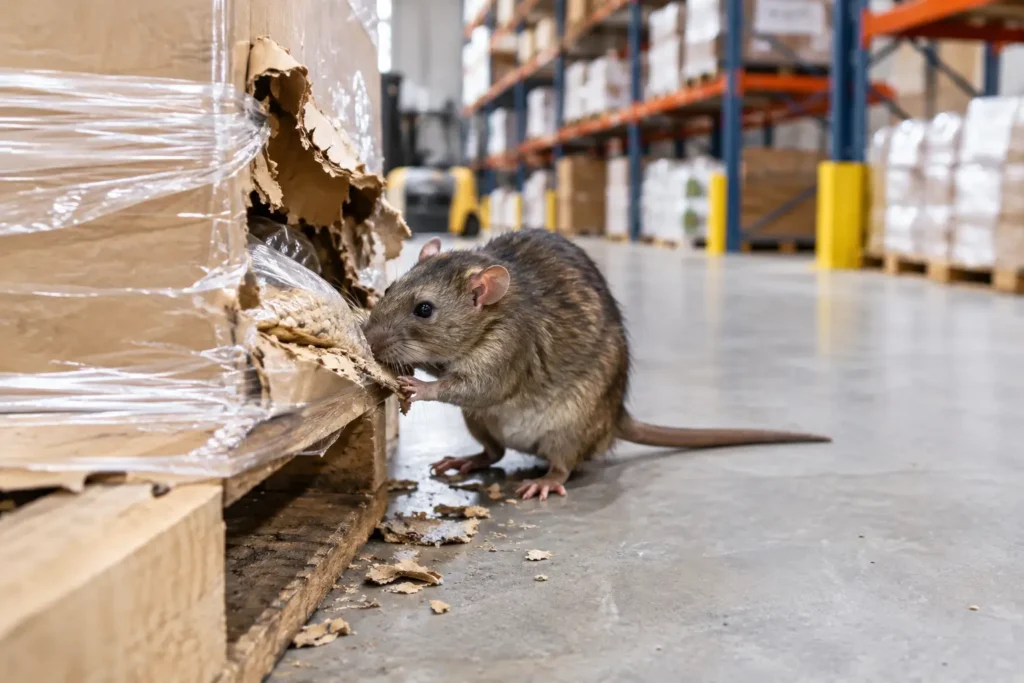
A single gnawed pallet corner or a few droppings behind stored inventory can signal a much larger issue. Rats in commercial warehouse spaces do not stay neatly contained near a loading dock. They travel through wall voids, rack systems, utility lines, break rooms, and storage areas, leaving contamination and damage in places employees may never see until the problem has grown.
For warehouse owners, facility managers, and operations teams, this is more than a pest-control inconvenience. Rodent activity can affect inventory, employee safety, sanitation standards, electrical systems, and business continuity. The right response is not simply placing a few traps. It requires finding where rats entered, removing the active population, addressing contamination safely, and closing the routes that allow reinfestation.
Why Rats Are a Serious Warehouse Problem
Warehouses offer the exact conditions rats seek: shelter, warmth, hidden travel paths, access to water, and in many cases food sources. Even facilities that do not store food can attract rodents through employee break areas, nearby dumpsters, standing water, landscaping, neighboring businesses, or damaged exterior doors.
Rats are also highly adaptable. A small opening around a pipe penetration, a gap under a loading door, a damaged roof edge, or an unprotected utility opening may be enough for access. Once inside, they often settle into areas with low foot traffic, including insulation, ceiling voids, mezzanines, equipment rooms, and spaces behind stored materials.
The damage can escalate quickly. Rats chew constantly to control tooth growth, which puts electrical wiring, data cables, packaging, plastic piping, wood, and insulation at risk. They can also contaminate surfaces and stored materials with droppings, urine, nesting debris, and fur. In a facility that handles food, pharmaceuticals, paper goods, textiles, or other sensitive inventory, even a limited rodent event can lead to costly disposal and documentation requirements.
Signs of Rats in a Commercial Warehouse
Visible rats are an obvious sign, but they are not the only one. In many cases, activity begins after hours and stays hidden during the workday. Early recognition gives a facility a better chance to limit contamination and avoid wider damage.
Look for fresh droppings along walls, behind inventory racks, near receiving areas, around dumpsters, and inside utility rooms. Rat droppings are generally larger than mouse droppings and may appear shiny or moist when fresh. Smear marks or greasy rub marks along lower walls and pipes can also indicate regular rodent travel routes.
Gnaw marks deserve immediate attention, especially around wiring, doors, pallets, cartons, and plumbing lines. Other warning signs include shredded cardboard or insulation used for nesting, unexplained odors, scratching sounds above ceilings or within walls, and product packaging that has been chewed or torn.
A warehouse may also show operational clues. Repeated false alarms from damaged wiring, unexplained equipment issues, product losses, or recurring droppings in the same zone often point to an access route or nesting area that has not been identified.
The Risks Go Beyond Damaged Inventory
Rodent contamination creates health and workplace concerns. Droppings, urine, saliva, and nesting materials can contain organisms that may become airborne when disturbed, swept, or vacuumed incorrectly. Employees should not be asked to dry sweep large accumulations of rodent waste or handle contaminated insulation and debris without proper training and protective equipment.
Odor is another concern. Urine can soak into porous materials, insulation, cardboard, unfinished wood, and other building components. Removing visible droppings alone does not necessarily remove the source of the odor. If rodents have nested in wall cavities, ceilings, or concealed mechanical spaces, contamination can remain long after trapping begins.
There is also a fire and downtime risk. Chewed electrical wiring may expose conductors, cause equipment failures, or create hazards that require emergency repair. A rat problem near electrical panels, refrigeration equipment, conveyors, or communications systems should be treated as a facility-maintenance priority, not just a sanitation issue.
What to Do When You Find Rat Evidence
The first priority is to protect people and prevent the issue from spreading. Keep employees away from heavily contaminated areas until they can be assessed. Avoid moving contaminated inventory through clean zones, and document where evidence was found, including dates, locations, photographs, and affected materials.
Next, identify whether products or packaging may have been exposed. The appropriate response depends on what the warehouse stores, how materials are packaged, and any industry-specific regulations that apply. Food and medical-product facilities may need a more formal response than a warehouse storing sealed hardware, but both need clear containment and sanitation procedures.
Do not assume the problem is resolved after a rat is caught. Trapping can reduce activity, but it does not fix the opening that allowed access or remove contamination from hidden nesting areas. A professional inspection should evaluate the exterior perimeter, roofline, loading areas, utility penetrations, drains, wall voids, attic spaces, and other likely access points.
A Complete Rat Response Has Four Parts
Effective warehouse rodent control is a sequence, not a single service visit. The work should begin with a detailed inspection that maps rodent evidence, entry points, travel paths, nesting areas, and conditions that support activity.
1. Remove Active Rodent Activity
A qualified commercial pest professional can determine the appropriate trapping and control strategy for the site. The method should account for the warehouse layout, employee access, product sensitivity, and the presence of food or regulated materials. Monitoring is essential because one successful capture does not prove the colony or travel route is gone.
2. Remove Contaminated Materials Safely
When droppings, urine, nesting debris, or damaged insulation are present, the affected materials may need specialized cleanup. Technicians should use appropriate protective gear and containment practices to reduce the chance of spreading debris through the facility. Depending on the extent of contamination, this can include removing nesting materials, cleaning affected surfaces, treating odor sources, and disposing of unsalvageable materials.
3. Sanitize and Restore Affected Areas
Cleanup is not only about appearance. Areas with rodent waste need proper sanitization, especially where contamination has affected insulation, storage surfaces, air pathways, or concealed building cavities. If insulation has been used as nesting material or saturated with urine, replacement may be necessary to restore odor control and building performance.
4. Seal Entry Points and Correct Conditions
Exclusion is what turns a temporary reduction in activity into long-term protection. Openings around pipes, doors, vents, roof edges, conduits, and utility lines should be sealed with durable materials suited to the building. Door sweeps, loading dock seals, screened vents, repaired wall gaps, and protected exterior openings can make a major difference.
Sanitation and site maintenance also matter. Keep dumpsters closed and positioned away from entry doors when possible. Remove standing water, reduce clutter along exterior walls, rotate stored goods, and keep palletized inventory away from walls so teams can inspect behind it. These steps will not replace exclusion, but they reduce the conditions that make the facility attractive to rodents.
Why Warehouse Rodent Problems Often Return
Reinfestation usually happens when the response focuses only on what is visible. A facility may set traps, remove a few rodents, and clean the floor, while an opening above a dock door or around a rooftop utility line remains untouched. Rats continue entering, and the cycle starts again.
The other common issue is incomplete cleanup. A warehouse can look clean while contaminated insulation, nesting debris, or odor sources remain in a ceiling cavity or wall void. That is why facilities benefit from treating rodent control, contamination cleanup, structural repairs, and prevention as connected parts of the same job.
When to Call for Professional Help
Call a qualified professional promptly if you find repeated droppings, nesting material, damaged wires, urine odor, chewed inventory, or evidence of rats near food, employee areas, or electrical equipment. Immediate help is also warranted when contamination is widespread, rodents are entering occupied workspaces, or a facility cannot identify where activity is coming from.
For Southern California property owners managing warehouses, a fast inspection can prevent a small discovery near a loading dock from becoming a contamination, safety, and repair issue across the building. The goal is simple: remove the hazard, restore affected areas, and make sure rats do not have a way back inside.
A warehouse should support safe work and reliable operations, not provide shelter for rodents. Acting early protects inventory and equipment, but more importantly, it helps protect the people who rely on the facility every day.