
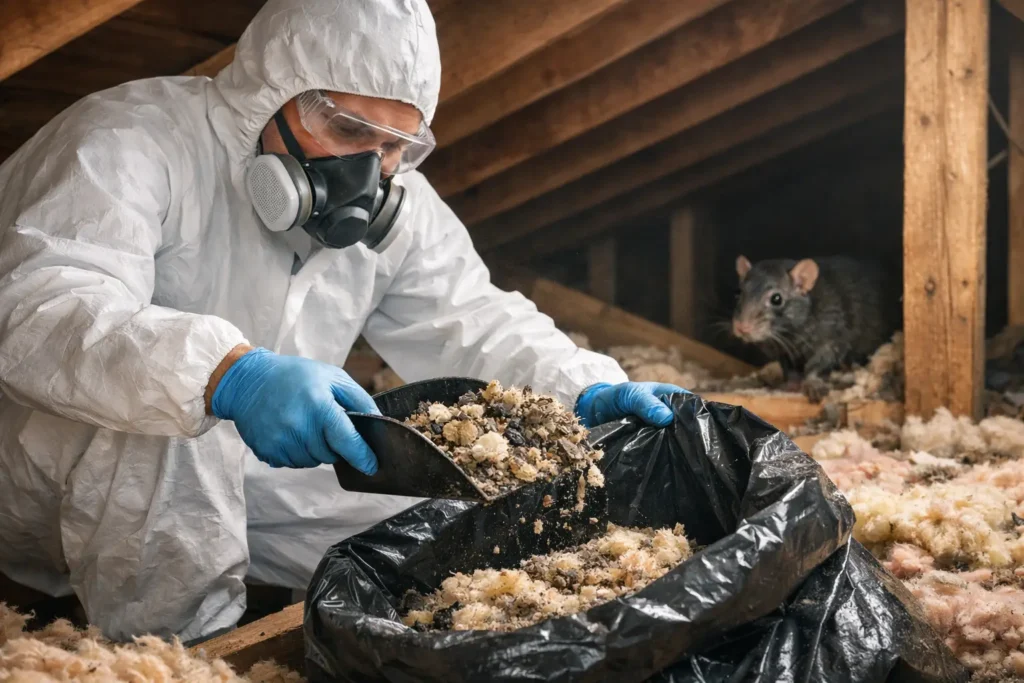
A proper attic rat clean up is not a quick sweep, a few traps, and a deodorizer. When rats have been living above your ceiling, they leave behind droppings, urine, nesting debris, damaged insulation, and odor that can affect the condition of your home long after the animals are gone. The work has to address the contamination and the reason rats got inside in the first place.
For homeowners, the hard part is that most of the damage is out of sight. You may notice a sharp urine smell, scratching at night, a sudden increase in energy bills, or droppings near an attic access point. By the time those signs are obvious, insulation may already be compacted, contaminated, or pulled apart for nests. Don’t wait for the odor or activity to spread into living areas.
Why attic rat contamination needs more than pest removal
Removing rats is necessary, but it is only the first phase. A pest-control-only approach can leave contaminated insulation and nesting materials in place, along with the urine residue causing lingering odor. It can also leave openings at rooflines, vents, utility penetrations, and other vulnerable exterior areas. That creates the same conditions for the next rodent to move in.
Rats can contaminate broad sections of an attic without leaving obvious damage at the access hatch. They travel along framing, burrow into insulation, and use secluded corners for nesting. Their droppings and urine may be concentrated in one area or scattered across the attic. If insulation has absorbed contamination, surface cleaning alone is not a reliable restoration solution.
There is also a home-performance concern. Insulation flattened by traffic, soaked with urine, or torn apart for nesting does not insulate as intended. That can make rooms below the attic harder to heat or cool and place more strain on your HVAC system. A thorough cleanup protects both the health conditions of the space and the home investment beneath it.
What professional attic rat clean up involves
The right scope depends on how long the rats were active, how extensive the contamination is, and whether insulation can be safely retained. A professional inspection should identify active entry points, locate nesting and contamination areas, assess insulation condition, and determine whether odors have traveled beyond the attic.
Containment and safe removal
Rodent waste should not be dry-swept or vacuumed with ordinary household equipment. Disturbing droppings and contaminated dust can send particles into the air. Trained technicians use appropriate protective gear, controlled removal methods, and equipment designed for contaminated attic materials.
In heavily affected attics, the most dependable option is often to remove contaminated insulation and nesting debris completely. This allows technicians to access the attic floor, framing, corners, and penetrations that were hidden beneath the insulation. Partial removal can make sense when contamination is limited and clearly isolated, but it should be based on what the inspection finds, not on what appears easiest or least expensive at first glance.
Sanitization and odor treatment
After contaminated materials are removed, the exposed attic surfaces need professional treatment. The goal is not to mask odor with fragrance. It is to treat the organic residue that allows the smell to persist.
Urine odor can become stronger during hot Southern California weather, when attic temperatures rise and odors move through small gaps around recessed lights, ceiling penetrations, and ductwork. A thorough sanitization process targets the affected surfaces before new insulation is installed. Where odor is severe or contamination has reached additional materials, the recommended treatment may need to expand accordingly.
Insulation restoration
New insulation is not simply a cosmetic final step. It restores the thermal barrier that helps your house maintain more consistent indoor temperatures. The appropriate insulation type and depth depend on the attic configuration, existing conditions, and local requirements.
Replacement should happen after removal, sanitization, and any needed repairs are complete. Installing new insulation over contaminated material can trap odor below it and make future inspection far more difficult. Clean first, restore second.
Exclusion that locks rodents out
The cleanup is only as lasting as the exclusion work behind it. Rats can enter through surprisingly small gaps and often exploit openings created by aging construction, loose screens, damaged vents, roofline gaps, and unsealed utility entries.
A complete remediation plan identifies and seals those access points with durable materials suited to the location. This is different from placing traps and hoping activity stops. Trapping may reduce the current population, but exclusion closes the route that allowed the infestation to develop. It is the step that helps keep your newly cleaned attic from becoming contaminated again.
Signs the attic may need full restoration
Not every rat issue requires insulation removal, but a few warning signs usually call for a closer professional assessment. Strong or recurring urine odor, widespread droppings, visible nests, chewed or compressed insulation, dead rodents, insect activity around carcasses, and repeated rodent sounds are all reasons to act quickly.
Homeowners should also pay attention to stains on ceilings, unexplained odors near air vents, and rooms that suddenly feel hotter or colder than usual. These signs do not prove attic contamination on their own, but they can point to insulation damage or odor movement from above.
If you have already had rats removed but the smell remains, assume the job may be incomplete until the attic has been inspected. Odor does not necessarily mean rodents are still active. It often means the contamination left behind was never fully removed or treated.
Why DIY attic cleanup can create bigger problems
It is understandable to want to handle a small amount of visible droppings yourself. But an attic is a confined, dusty environment with poor lighting, unstable footing, electrical hazards, and concealed contamination. The biggest risk is not just contact with waste. It is unknowingly disturbing contaminated material and failing to locate the full extent of the problem.
DIY cleanup can also lead homeowners to replace insulation before entry points are sealed. That sequence is expensive because rats may return and damage the new material. In other cases, a homeowner treats the odor but leaves nests, droppings, or urine-soaked insulation behind. The attic may look better at the hatch, while the contamination remains across the rest of the space.
Professional Rodent Cleanup approaches the work as a complete restoration project: remove the contaminated materials, sanitize affected areas, restore insulation when needed, and seal the points rodents use to enter. That approach is designed to solve the whole problem rather than temporarily quiet it.
What to expect from an inspection
A useful inspection should give you a clear picture of what is happening overhead, not a vague recommendation for more traps. The technician should inspect the attic condition, look for evidence of current and past activity, assess insulation damage, and evaluate the exterior for entry points.
You should also receive a straightforward explanation of what needs to be removed, what can be retained, how sanitization will be handled, and what exclusion work is necessary. The answer will vary by home. A recent, contained issue may require focused treatment, while a long-term infestation may warrant full insulation removal and replacement. Clear scope matters because it helps you understand what is being restored and why.
For homes in Los Angeles, Orange, Ventura, Riverside, and San Bernardino counties, prompt service can be especially valuable when heat is intensifying attic odors or active rodents are causing ongoing damage. A free, no-obligation inspection gives you a practical starting point without committing to work before you understand the condition of the space.
A clean attic should not just look clean at the access opening. It should be sanitized, properly insulated, free of contaminated nesting material, and sealed against the next rodent looking for shelter. When you address all four, you can stop worrying about what is happening above your ceiling and get back to feeling comfortable in your home.