
Schedule a Professional Inspection: 833-END-RATS (833-363-7287)
An attic can look quiet from the hallway below while urine odor, droppings, shredded nesting material, and contaminated insulation are sitting directly above the living space. That is why attic cleanup companies are not simply hauling services or general cleaners. A proper rodent cleanup requires contamination control, safe material removal, sanitation, odor treatment, and a plan to stop rodents from returning.
For homeowners in Sherman Oaks, Encino, Pasadena, Thousand Oaks, Irvine, and throughout Southern California, the problem often becomes obvious after the rodents are gone. The scratching stops, but the odor remains. HVAC use may push the smell into bedrooms or offices, and damaged insulation can no longer do its job. For landlords, property managers, warehouse operators, and school facility teams, an affected attic can also create a maintenance issue that needs clear documentation and careful handling.
What Attic Cleanup Companies Should Inspect First
A professional cleanup should begin with an inspection, not a quote based only on attic square footage. The goal is to identify what is contaminated, how far the activity extends, and whether there are active or accessible entry points.
Technicians should look beyond visible droppings. Rodents often travel along framing, duct runs, utility penetrations, wall tops, and the perimeter where rooflines meet exterior walls. Urine staining can be hidden under insulation. Nesting debris may be concentrated near heat sources, wiring, or stored materials. In commercial properties, the same contamination can appear above drop ceilings, inside wall voids, and around storage areas.
The inspection should also distinguish between localized contamination and an attic where insulation has been broadly affected. That matters because spot cleaning may be appropriate for a small, contained area, while extensive urine odor and droppings throughout loose-fill or batt insulation may call for removal and replacement. The right scope depends on the condition of the materials, the level of contamination, and whether odors have penetrated surrounding surfaces.
A good inspection also addresses prevention. Cleaning an attic without identifying likely rodent access points can leave the property vulnerable to another infestation. Exclusion work is not a substitute for cleanup, and cleanup is not a substitute for exclusion. A lasting solution needs both.
Cleanup Is More Than Removing What You Can See
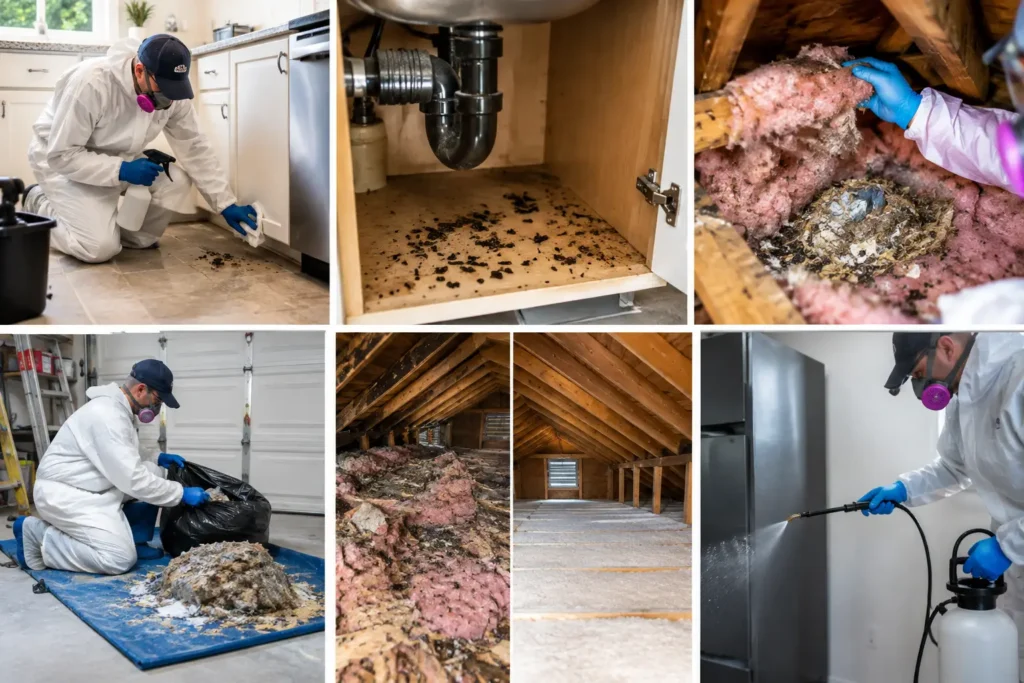
Rodent waste should never be dry swept, brushed, or collected with an ordinary household vacuum. Those methods can disturb contaminated particles and spread them into the air. Cleanup professionals use appropriate personal protective equipment, controlled work practices, wet disinfecting methods with the correct contact time, sealed disposal procedures, and specialized HEPA equipment when the situation calls for it.
Before removal begins, the work area should be prepared to limit the movement of dust and debris into clean parts of the property. Depending on the attic layout and contamination level, this can include access protection, containment, and controlled pathways for removing bagged material. This preparation is especially valuable in occupied homes, multifamily buildings, and businesses that need to keep operations moving.
Contaminated nesting debris, droppings, and damaged insulation are then removed carefully and sealed for disposal. Insulation removal is often the most overlooked part of attic restoration. It may still look intact from the access opening, but insulation that has absorbed rodent urine or contains widespread droppings can continue to hold odor. Covering it with deodorizer or adding new insulation on top does not remove the contamination underneath.
Once affected materials are removed, exposed surfaces can be treated with targeted sanitation. This is not a claim that an attic can be made sterile. The purpose is to reduce remaining contamination on accessible surfaces and address the conditions left behind by rodent activity. Areas commonly treated include framing, attic decking, accessible duct exteriors, pipe penetrations, and other surfaces where evidence is present.
Odor Removal Requires More Than a Fragrance
Persistent rodent odor is one of the main reasons property owners call after an infestation has already been addressed. Urine odor can linger in insulation, wood, dust, and concealed voids. Warm weather can make it stronger, which is why some Los Angeles and Inland Empire homeowners notice the issue most sharply during hot afternoons.
A professional odor-control plan starts by removing the odor source. After contaminated materials are addressed, targeted treatments and proprietary rodent scent neutralization can help reduce lingering odor on remaining affected surfaces. The trade-off is straightforward: deodorizing may improve a mild, isolated odor, but it cannot reliably overcome heavily contaminated insulation that remains in place.
Be cautious of any service that promises to solve a serious attic odor with a quick spray alone. Ask what materials are being removed, what surfaces will be sanitized, and how the company determines whether replacement insulation is needed. Clear answers are a sign that the scope is based on conditions, not a one-size-fits-all package.
When Contaminated Insulation Needs Replacement
Insulation does not automatically need to be removed after every rodent sighting. A small amount of recent, localized activity may allow for focused cleanup if the surrounding insulation is clean and dry. But widespread droppings, repeated nesting, strong urine odor, matted insulation, or long-term activity can make replacement the practical choice.
Removal creates an opportunity to inspect the attic structure more clearly. Technicians can identify hidden nesting zones, damaged air ducts, chewed materials, and gaps around plumbing, electrical, or ventilation penetrations. After cleanup and necessary repairs, new insulation can be installed as part of restoring the attic’s thermal performance.
For property managers, this approach can be particularly useful between tenants. It addresses sanitation, odor, and property condition together instead of leaving a questionable attic for the next resident. For warehouses, offices, and schools, the work may need to be planned around access restrictions and operational schedules. An experienced cleanup company should explain those site-specific considerations before work starts.
Questions to Ask Before Hiring an Attic Cleanup Company
Not every company that offers attic cleaning performs rodent contamination restoration. Ask whether the crew handles rodent droppings, urine odor, nesting debris, contaminated insulation, sanitation, deodorization, and exclusion coordination as part of a defined process.
You should also ask how they protect occupied areas during removal, whether they use appropriate protective equipment and HEPA equipment when needed, and how contaminated materials are sealed and disposed of. If the answer centers on sweeping, vacuuming with standard equipment, or simply spraying a fragrance, the work may not address the actual condition of the attic.
It is also reasonable to ask about insurance, licensing where applicable, warranties on qualifying exclusion work, and whether the company has hands-on experience with both residential and commercial properties. Attic contamination in a single-family home in Woodland Hills is not identical to contamination above units in an apartment building or within a Rancho Cucamonga warehouse. The core safety principles are the same, but access, containment, scheduling, and restoration needs can differ.
Prevention Is Part of Restoring the Space
The final step should focus on why rodents gained access in the first place. Openings around roof transitions, vents, utility lines, eaves, and structural gaps can allow repeated entry. Poison-free exclusion is a practical option for property owners who want to close access points without relying on toxic bait around homes, pets, residents, or business operations.
A thorough plan identifies accessible entry areas, addresses them with durable repairs, and accounts for the conditions that attracted activity. In some properties, that may include correcting damaged screens or gaps around utilities. In others, it means coordinating cleanup after rodent control has confirmed activity is no longer ongoing. The order matters: sealing too early without accounting for active rodents can create new problems inside the structure.
Professional Rodent Cleanup brings more than 20 years of hands-on rodent cleanup and restoration experience through Rodents Stop to contaminated attics, crawlspaces, wall voids, garages, and commercial spaces across Los Angeles, Ventura, Orange, Riverside, and San Bernardino counties. The work is built around careful inspection, controlled removal, targeted sanitation, odor neutralization, restoration, and prevention – not a temporary cosmetic fix.
If your attic still smells after rodents are gone, insulation shows visible contamination, or you are managing a property with recurring activity, do not wait for the problem to spread into occupied areas. A professional inspection gives you a clear picture of what needs to be removed, cleaned, restored, and sealed so the space can move toward a healthier, more usable condition.